







Many folks on the Interwebs have been speculating that the whole thing in this season of Picard with the Borg Queen inside Jurati’s head is a riff on what the 2000s version of Battlestar Galactica did with Baltar sharing his mind with Six and conversing with an image of her that only he could see. Part of their evidence is that Jurati is a blonde wearing a red dress, just like Six. My general response to that has been, “Jimmy Stewart and his bunny rabbit would like to have a word,” as BSG was hardly the first use of such a trope. It wasn’t even the first science fiction show to use it, as Farscape got there with Crichton and Scorpius three-and-a-half years before BSG’s debut.
But then this week they go and cast James Callis (Baltar on BSG) as a guest star. So who the hell knows?
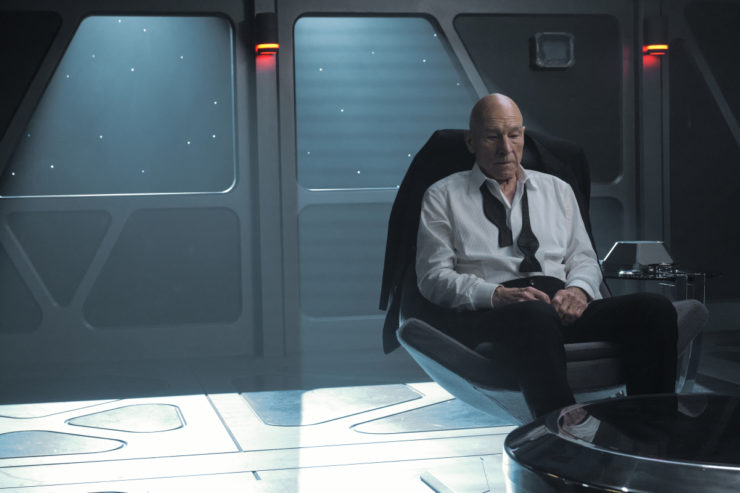
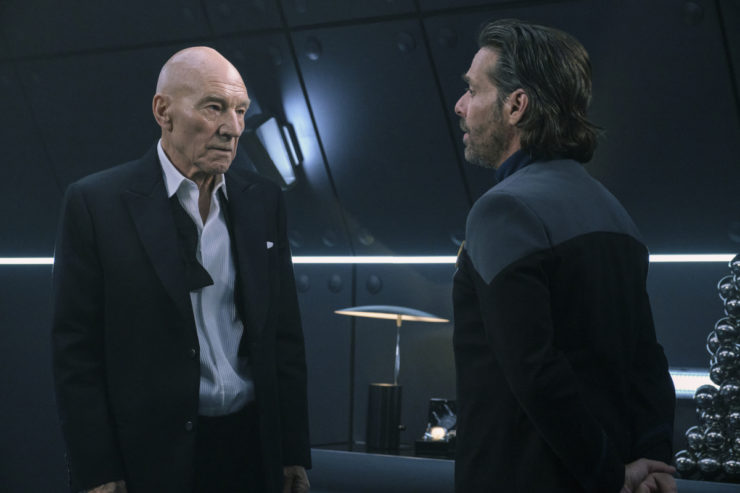
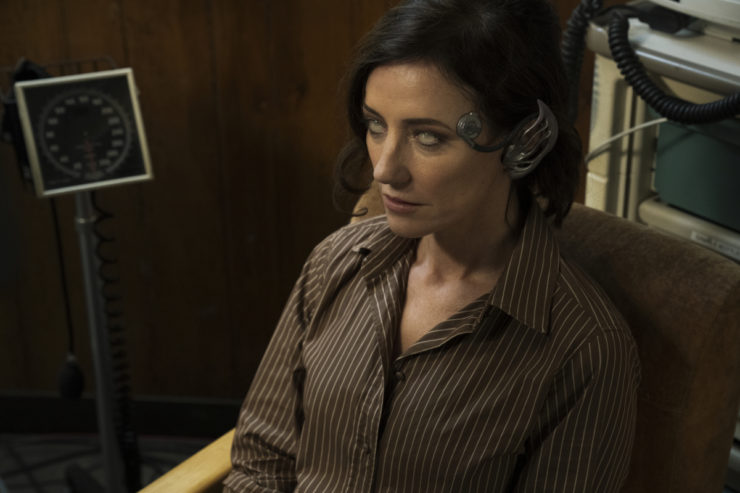
As threatened last week, the bulk of this episode focuses on Tallinn ENTERING PICARD’S BRAIN! We, in fact, start out there, with Picard still in his 2024 tuxedo, but sitting in a starship ready room, though it’s not clear whether it’s supposed to be the one on the Stargazer, the Enterprise-D, the Enterprise-E, or some other ship Picard served on/commanded. He’s having a session with a counselor, played by Callis, and it’s obviously partly inspired by a memory he had of a psych evaluation he underwent to determine if he could still command. Given all the shit Picard went through on TNG alone—being assimilated by the Borg, living someone else’s life for thirty-five subjective years, being tortured by a Cardassian gul, an intense mind-meld with a senile Vulcan—I daresay he had a bunch of those over the years.
But Tallinn doesn’t intrude on that colloquy. Instead, she goes to a different part of the admiral’s mindscape, his reinterpretation of something that happened when he was a small boy. His mother grabbed him and took him to the underground tunnels—used, as established in “Watcher,” during World War II—to escape. Picard tells the story to the counselor as escaping a monster, and the images we see all hint at it being Picard’s father who is that monster. From the beginning of this season, we have been prompted for the notion that Picard’s father Maurice was an abuser.
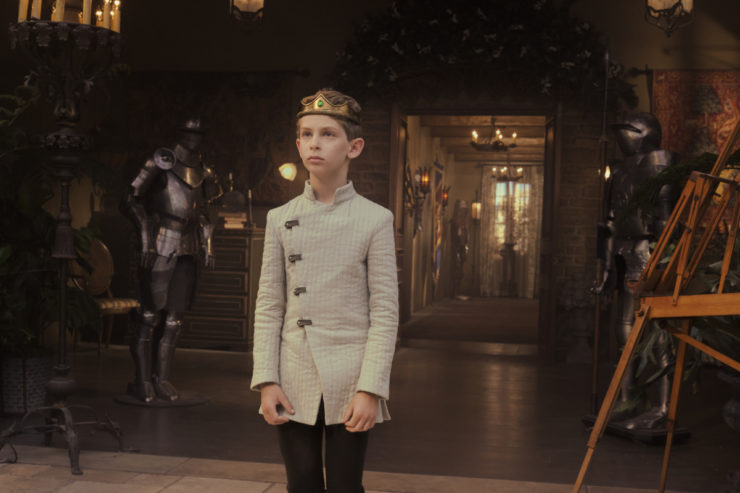
What we knew about Maurice prior to this season of Picard came from two sources on TNG: “Family,” in which we learned he was a Luddite who refused to use modern technology in his life or his work (a mode of living followed by his older son, Robert), and “Tapestry,” in which we see a Q-created image of Maurice telling Picard how disappointed he was in him.
The leap from that to abuser is, truly, not a particularly big one. But we live in an age where storytellers have a preference for Big! Twists! You don’t see coming! Except, of course, they’re so common that you do see them coming, and I saw this one a star system away. Because the truth is, apparently, that his mother Yvette was running away from an imaginary monster. She was mentally ill, and Maurice tried to take care of her, but wasn’t always able to. Eventually, Callis’ counselor is revealed to actually be Maurice.
One of the theories being thrown around regarding this plot point was the idea that Maurice killed Yvette. This is at odds with the one on-screen appearance Yvette made prior to 2022, as a hallucination of Picard’s in TNG’s “Where No One Has Gone Before,” in which she’s way way older than Madeline Wise. And sure enough, Maurice apparently did not kill her.
I say “apparently,” because while we do get that revelation when we ENTER PICARD’S BRAIN!, we are also explicitly told that there’s more to it. Coming to understand the truth about his mother’s mental illness (which Picard didn’t really comprehend as a boy and probably denied/repressed as an adult, especially since he spent so little time at home after joining Starfleet, including not at all in the twenty years prior to TNG’s fourth season) is enough to get him out of his coma, at least, but Tallinn very specifically says that the story isn’t over yet.
But we’re getting back to that some other time, I guess. Instead, we have to find Jurati.
In this episode, someone finally remembers that Seven of Nine is a former Borg drone who has had multiple direct dealings with the Borg Queen, and that maybe she should sorta kinda be involved in the Jurati-Borg Queen plotline. With Rios standing guard over Tallinn while she ENTERS PICARD’S BRAIN!, Seven and Musiker go back to La Sirena to try to track Jurati down. But La Sirena’s systems have been encrypted, and it’s a Borg encryption. Seven is able to eventually get through it (you’d think the Queen would have accounted for that), and call up sensor logs, which show that Jurati’s the one who did that.
They try to track her down, first to a club where she broke a window. Seven says that was for the endorphin rush, which will make the Queen more powerful. This is the second time they’ve discussed this particular aspect of assimilation that hasn’t gotten much play in other Borg episodes: the initial process of assimilation is a joyous one. This is at odds with the assimilation of Picard in “The Best of Both Worlds, Part II,” where we saw a tear going down his cheek, but it also explains why resistance is so futile. And it makes sense, anyhow, that the process would at first feel pretty good, because it will cut down on that oh-so-futile resistance.
Buy the Book

The City Inside
Seven and Musiker are now genuinely worried, because if Jurati is about to become the new Borg Queen in 2024 Los Angeles, the change in history that Q showed them is a beneficent utopia by comparison.
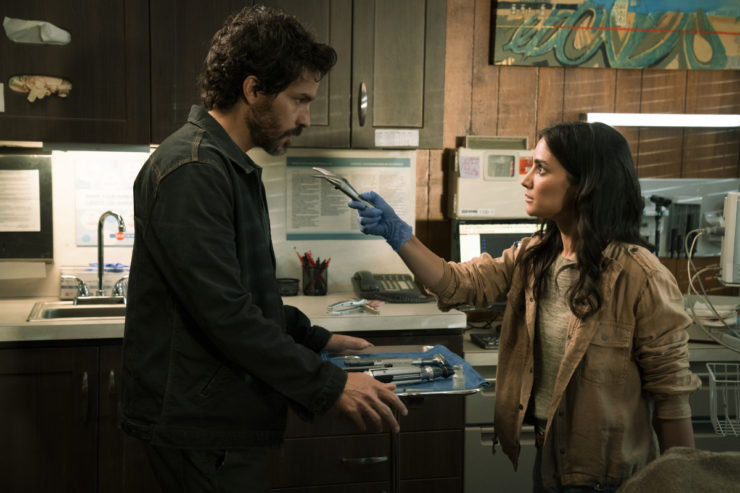
Rios has to deal with Ramirez and her son, who show up at the clinic just as Rios needs a neural stimulator to settle Picard’s brainwaves down while Tallinn is ENTERING PICARD’S BRAIN! Ramirez is freaked out by the combadge, the transporter, and the four-hundred-years-in-the-future tech. This gives us yet another The Voyage Home callback—Ramirez asks if Rios is from outer space, and he says he’s from Chile, he just works in outer space, and reader, I LOL’d—and more of Rios flirting with Ramirez and bonding with her kid. The end result of this is Rios beaming over to La Sirena with Ramirez mère et fils, which is a spectacularly stupid idea, especially given that (a) this isn’t really Rios’ La Sirena, it’s a ship that’s part of the Confederation, and (b) it’s all full of nasty-ass Borg encryption and stuff. These are both things that are very likely to bite Rios and the Ramirezes on their proverbial asses. Still, up until that ending, the scenes with the three of them are fun. Santiago Cabrera and Sol Rodriguez have a nice chemistry, and Steve Gutierrez is fantastic as Ricardo. I especially loved when Ramirez told Ricardo to cover his ears as she was about to use bad language, and after she chews Rios out in Spanish, Ricardo complains that she didn’t even use the good swear words!
ENTERING PICARD’S BRAIN! was a rather large disappointment, as the insights into Picard were not particularly revelatory or interesting (though Callis was excellent as both counselor and father). The Rios-Ramirez stuff was cute and the Seven-Musiker stuff was all setup, albeit necessary setup.
But then we get the end of the episode. Picard is determined to talk directly to Q to find out what the hell is going on, and he knows someone who should be able to summon Q: Guinan.
Thus, “Monsters” finally explains a dangling bit from TNG’s second season. When Q showed up on the Enterprise in “Q Who,” we found out that he and Guinan had a history. Guinan made a gesture that was very similar to what Dr. Strange does when he casts spells, as if to ward him off.
This relationship was never really explicated after that. It was seen again in “Déjà Q,” but that was it.
That’s finally no longer the case. Guinan discusses the relationship between the Q-Continuum and the el-Aurian people, including the power that food and drink have to el-Aurians—already established as good listeners, and what better way to listen to people than over a meal or a drink? It’s a lovely concept, and Guinan then whips out a special drink that holds the essence of that agreement between the Q and Guinan’s people. And when Guinan does the summoning, she makes the same Dr. Strange hand gesture!
As groovy as that is, what’s even more interesting is that it doesn’t work. There’s obviously something very wrong with Q—first Picard asked if he was ill in “Penance,” then his Mighty Finger Snap Of Doom stopped working at the end of “Watcher,” and he was reduced to bribing Adam Soong for help in “Fly Me to the Moon.”
Guinan and Picard’s discussion about this unexpected failure to communicate is quickly interrupted. Callis isn’t the only star of an excellent early 2000s TV show to guest star this week: we also get Jay Karnes (of The Shield, and who also played a time agent in Voyager‘’s “Relativity“) playing someone who appears to be a goofy guy wanting to come into Guinan’s place for a drink, but who turns out to be a federal agent. He has security cam footage of Picard’s beam-in to Guinan’s bar in “Watcher,” and won’t take Guinan’s insistence that that camera glitches all the time for an answer. And so for the second time this season, an episode ends with one of our main characters and one of our guest stars getting arrested.
We also get the revelation that Tallinn is really a Romulan, and really? So apparently she’s a distant ancestor of Laris, and she looks just like her because that’s totally how genetics works. Look, I’m willing to accept that every male member of the Soong family is played by Brent Spiner as a conceit of dramatic television, but having the characters actually act as if they all look alike is yet another strangling of my disbelief.
I’m also a little disappointed that, after all that buildup, Renee’s fate is fobbed off in a quick line of dialogue from Tallinn, informing Picard that she made it to quarantine just fine. I know lots of people in the comments last week liked it, but I still was utterly unmoved by Picard’s pep talk to Renee, and after all the buildup of her being the turning point and Q spying on her and wanting to finger-snap her into whatever he had planned, this is very anticlimactic.
Of course, there are still three episodes to go. She could be back. Though I suspect most of the plot focus is going to be on Jurati-as-Borg-Queen…
Keith R.A. DeCandido will be at Indiana Comic Con this coming weekend at the Indiana Convention Center. He will be at Bard’s Tower, booth 1536, selling and signing his books alongside fellow authors John Jackson Miller, Gama Martinez, Rick Heinz, Brian Anderson, Joe Asphahani, and Valerie Willis. Other Trek folks who’ll be there include actors Gates McFadden, Brent Spiner, John deLancie, and Carlos Ferro (Carlos will also be at Bard’s Tower with Keith). Keith will be doing panels as well—click here for details.

Speaking of “Reader, I LOL’d,” I certainly did at Ricardo’s “I’m gonna touch everything!” line. Wonderfully appropriate for a nine-year-old in that situation.
A bottle to summon Q? Good grief, if they’re going to be that silly, might as well throw in a cameo from Barbara Eden.
What happened to this season? Started so strong, now this…
Yeah, the El-Aurian/Q world-building is nice, but…I’m all but done with this Season.
If the final Season wasn’t including the TNG cast, I’d probably be calling it quits.
This is the second week in a row where the dialogue gave me the perfect headline for the review. This isn’t necessarily a good thing…..
—Keith R.A. DeCandido
I’m surprised by the negative reactions, since this was the most satisfying episode of the season for me. It finally stopped wasting time with plot sidebars and continuity porn (though we got a bit of that with “I just work in outer space”) and told the story they’ve been teasing all season, and it was pretty effective. Although the revelation about Picard’s mother hit a bit too close to home for me, for reasons I won’t go into. And the writing in general, the dialogue, was pretty good overall. A good script by Jane Maggs. Nice to see an episode driven more by character interplay than gimmicky cinematic plot twists.
I did have issues, though. I appreciate the effort to pick up the dangling mystery about Q and Guinan’s history from “Q Who?,” but the “explanation” just raises more questions. The El-Aurians have always been shown to be fairly ordinary humanoids, so why would the Q have had a conflict with them and why would they have been equally enough matched for it to be resolved with a truce? The Q could’ve just snapped them out of existence.
And the attempt to “explain” why Tallinn looks like Laris just makes it worse. Okay, lookalike ancestors are an old trope, and not unheard of in Trek (aside from the Soongs, there’s Colonel Worf, and Shannon O’Donnell and T’Mir if you take “11:59” and “Carbon Creek” literally), but what are the odds that, out of billions of humans and billions of Romulans, this person who’s vital to Picard’s mission would just coincidentally happen to be an ancestor of Picard’s 24th-century romantic interest? It’s an incredibly feeble excuse to justify giving Orla Brady a regular role this season.
It’s also weird how the show keeps dancing around Raffi & Seven’s relationship. This is the first time they openly talked about it, and they were talking as if they considered each other soulmates for life, which is kind of out of nowhere since it’s the first explicit acknowledgment in dialogue that they’re even involved, as far as I recall. (I’m not counting the audio drama focusing on them. That’s what’s weird, that they relegate the relationship to a side story and virtually ignore it in the main show until now.)
So Baltar is Picard’s dad? I guess it fits, what with Picard kind of being a Cylon now. And now both Baltars have done Star Trek, so that’s nicely symmetrical.
I dunno. This season just isn’t fitting together for me. This whole thread of a buried element of Picard’s past just seems so pointless here. What does it add to his character? What does it have to do with this season? Why did we spend a whole episode on it? Why did it short him out now specifically? What’s the point of the Romulan deception? In a story about a divergence in the past, why are we spending time on one of our heroes being incarcerated — again! Last time it amounted to nothing except a way to kill an hour of screentime with a wild goose chase. Now it feels like we’ve spent another hour getting essentially nowhere, with a huge amount of plot still to cram into the last episode or two.
This season is all over the place. It’s nice we get some lore context for Q’s reaction to Guinan all those years ago. Weird they can summon Q… But I wouldn’t be shocked now if we get a lore drop that the Q were behind the Borg attacking them and nearly wiping this, annoyance, out.
The deep dive into Picard’s past was nice. Ok. It was something.
Yeah, glad they finally got the former Borg involved in the Borg random side plot. There’s enough going on. I hope they wrap this one up quick. Give JDL and PS more screen time together.
I won’t lie. Considering how connected the modern world is. I’m glad someone caught Picard on camera. But let’s make this quick.
@5 I think the clear implication is the Q had a conflict with the El-Aurians precisely because they couldn’t just wipe them out of existence. We’ve already seen that they have special abilities that allow them to see through alternate timelines; perhaps when they were gathered together on their home planet their abilities were augmented to the point where they could resist the reality-altering powers of the Q altogether, which made them dangerous to the Continuum.
I also enjoyed the episode, though I think I need to watch it again because I was not fully awake for the first half. I for one greatly appreciated the twist that Maurice Picard was not a monster and felt very sad about poor Yvette. I was pulled out briefly by the revelation that she apparently had a serious mental illness, since that seems like something 24th century humans would have hopefully been able to treat. Of course, they could always go with the old standby of making it SPACE mental illness caused by some sort of extraterrestrial pathogen or something. That would actually be a nice little explanation for Maurice and Robert’s technophobia.
@6/mastadge: “Why did we spend a whole episode on it?”
My question is the opposite — why did it take so long to get to it? The show is called Star Trek: Picard, after all. It’s supposed to be a character study of Jean-Luc Picard, offering new insights into who he is. They’ve been setting up these secrets about his traumatic childhood since the season premiere. But the storytelling has been too decompressed and meandering up to now, so the references to his past haven’t cohered as an arc the way they should have.
“Why did it short him out now specifically?”
Other way around. Getting run over by Adam Soong’s car put him in a coma, so he could no longer distract himself from the memories about his mother.
“What’s the point of the Romulan deception?”
I assume it’s self-evident why she disguises her ears among 21st-century humans, so I’m guessing your question is why she hid it from Picard. I’m guessing it’s because she’s used to living a hidden, unobserved life and sharing the truth about herself doesn’t come easily.
“In a story about a divergence in the past, why are we spending time on one of our heroes being incarcerated — again!”
I’m guessing it’s the same reason we’re spending time on the Borg Queen taking over Agnes and Rios telling Teresa the truth. This seems like the kind of time-travel story where, as Seven said, everything they do to try to fix the timeline just ends up screwing it up worse. Since this whole thing apparently has some personal importance for Q, I’d speculate that at the end, Q will fix it all with a finger snap out of gratitude, or something.
But I do agree that devoting a whole season arc to this story was not a great idea. It’s the sort of thing that works better at movie length. Dragging it out to a season requires a lot of padding and added complications.
@8/Chase: The idea that the El-Aurians were powerful enough to pose a threat to the Q is just the kind of retcon I have trouble believing. They’ve never been shown to have any special abilities beyond that time sense. And if they were that powerful, how were they devastated by the Borg? I mean, if humans are ants compared to the Q, the Borg are at most hornets. The Q are orders of magnitude beyond them. So they must be even more orders of magnitude beyond the El-Aurians.
@10 This episode also left me firmly convinced that they can’t actually fix the timeline and that they were never meant to. This was always supposed to be a personal journey for each of them in some form or another. Since I think that Picard’s decision to destroy the Stargazer was the catalyst for whatever has caused Q to lose his powers, it follows that all that’s necessary to fix the problem is for Picard to understand what led him to that decision and to resolve to handle things differently with a second chance. That would restore Q’s powers with him subsequently snapping reality back into place.
Solid point, Christopher. For a show named Picard, it is odd we’re just getting to this. All this family stuff would have fit nicely with all that focus on friends, family, and all that jazz from last season.
Maybe “threat” isn’t the right word, especially since Guinan called it a “cold war,” but I also think it’s worth considering that maybe the Q didn’t want to wipe out the El-Aurians or anybody else. The Borg might have been able to simply because their tactics are different and those tactics were able to exploit an El-Aurian weakness.
I’m seriously doubtful that they can wrap-up all of the outstanding plot threads for this season in a satisfying way within the next three episodes. Honestly, the only really compelling threads for me throughout this season have been Agnes’s seduction by the Borg Queen and whatever Q is up to with Soong, and neither of them are touched on at all here. And I found myself rolling my eyes when they had the FBI randomly show up, because the last thing this season needs is more bloody sidequests.
If the FBI agent is actually Ducarne himself, then maybe it’s not a side quest at all but the vehicle for Picard learning how much damage they’re causing to the timeline so they can actually fix things.
I thought this episode was great, finally bringing the season-long arc back on track in a satisfying and engaging way.
At the point when Young Guinan tries and fails to summon the Q, was it just me or was there a murmuring sound effect like that used to represent the Borg?
@13/Chase: Calling it a cold war just makes it worse, because it implies the El-Aurians were a match for the Q in power, which is just unbelievable. But then, it was unbelievable when “Q Who?” showed Q acting as if he was afraid of Guinan, so I guess it’s not a new problem. Still, as I said, it’s an “explanation” that just makes the matter more confusing rather than less.
@6 “What’s the point of the Romulan deception?”
To be fair, deception is kinda the Romulan stereotype. I don’t know whether that’s what the writers had in mind, but it fits.
Personally, I don’t think Tallinn and Laris are related. My money’s on them somehow making Tallinn and Laris the same person. Either Tallinn is long-lived, due to either Romulan genes or some sort of life-extension treatment due to being a Supervisor, and she’s assigned to the entire Picard line up to and including Jean-Luc in the 25th century, or, what I think is more likely: due to the time travel shenanigans from this season she ends up in the future but not quite as far as 2401, where she finds her way into Picard’s life again, but due to the whole Supervisor thing (or polluting the timeline or whatever) can’t tell him about his 21st century romp, and her season 1 persona, including her marriage, was a deep cover story.
@15/Chase – I like the idea that it’s actually Ducane himself, but it’s not clear to me why he would feel the need to masquerade as an FBI agent, given that Picard would already be familiar with 29th century time travellers. Of course, it’s also possible that he’s the version of Ducane from the dystopian timeline.
This is the problem with the idea of multiple timelines overwriting one another; it loses all coherence almost immediately.
@10 “It’s supposed to be a character study of Jean-Luc Picard, offering new insights into who he is. They’ve been setting up these secrets about his traumatic childhood since the season premiere.”
That’s fair, and perhaps a large part of my problem is in the presentation, but my question remains . . . what is this really revealing to us about Picard? I don’t feel like I understand him better as a person now/yet. I’m not really sure how this backstory fits into the story of this season — except to the extent that this season is not actually about fixing timelines as it is about alienation and connection (both in the sense Forster intended and in the sense he’s most often quoted) and conflicts between desire and duty. But if those are the themes then the show has mostly been skewing way too far toward plotty shenanigans at their expense.
20.
It says that Picard has a tragic backstory, just as every single other character on this series has a tragic backstory.
At least in that one area they’re consistent.
@20/mastadge: “But if those are the themes then the show has mostly been skewing way too far toward plotty shenanigans at their expense.”
Well-put. That’s exactly the problem.
Young Jean Luc
Thought that was Bashir at the start
I’ve thought that James Callis looks and sounds distractingly like Alexander Siddig since the very first episode of the Galactica reboot.
@24: I thought that too! And I thought how apt since there were a couple of episodes of DS9 where characters went into other characters’ minds like in “Extreme Measures” when Bashir goes into Sloan’s mind, and in “Distant Voices” which takes place in Bashir’s mind during his comatose state.
That said, it was cool to have Callis appear here since I was a fan of BSG (2000’s). Until this review I hasn’t considered the similar parallel of Baltar and Six, and Jurati and the Borg Queen.
@25: I too also felt like Callis and Siddig look and sound alike. They could play brothers!
This episode also reminded me of the FX series Legion which was about the mutant David Haller, ironically, the son of Professor Xavier (although Patrick Stewart didn’t play this version of the character in the series). Legion focused a lot on Haller’s major mental health issues and even had an episode where his love interest is implanted into his mind and encounters David as a child (and also running away from monsters).
Am I the only one who feels like the timing was off in several episodes? I am not sure I understand why the end when they do. For example last weeks episode clocked in at 38 minutes which is really short especially since the first 30 minutes or so of today picked up exactly where they left off. Then the last third of this episode felt like the start of the next one. It just continually feels off.
I also agree with what several people have said which is we are getting arrested again? I’m assuming this guy is slightly more than a federal agent or else why would you bother doing all of the him chatting up Picard and Guinan. For that matter why else would he be surveillance Guinans bar. Meanwhile everyone else keeps going to La Sirena and just missing each other….
On a better note I liked James Callis turn as Maurice/the internal psychologist and I could understand how Robert got to be who he was.
I’m sticking around to the end of the season to see how it ends but I can honestly say i have no need to ever rewatch this season of Tre
@27/MikeKelm: The episode lengths are arbitrary. Rather, they end where the director, writer, or showrunner, feels the episode completes the intended segment of a particular arc as long there is enough material to be considered an “episode.” On a streaming format, the producers no longer have to worry if they have enough material to fit a standard hour of broadcast time like pre-streaming Trek series had to do. Therefore, you have episodes that seem kind of short like the last one, which itself seemed padded due to the repeated flash-forward to the scene of Picard being struck by a car, before doing a flash-back to start an act; and other episodes that are significantly longer like generally season finales when the writers try to cram in as much material as possible. I believe everything is all story-boarded prior to filming so everything starts and stops in a given episode as intended.
@27/Mike Kelm: “For that matter why else would he be surveillance Guinans bar.”
He didn’t. A surveillance cam caught Picard when he materialized on the street corner outside, about half a block away from the bar. We live in an age when there are surveillance cameras everywhere in major cities, and this is two years into a future that’s gotten even more dystopian, so presumably there are even more cameras out on the streets.
It remains to be seen whether this means that the FBI has some kind of “X-Files” division whose job it is to keep an eye out for aliens and time travellers. I’m not sure how I’d feel about incorporating that into the Star Trek universe.
I agree, having yet another story detour where the characters get arrested feels redundant unless there is more going on here.
I have to keep reminding myself that this series is a character study of Picard and not a rip-roaring adventures in space series (we have Strange New Worlds to look forward to that). Therefore, I guess I have to sit through a lot of scenes delving into Picard’s psyche even though I didn’t find it all particularly interesting. I suppose nowadays every character needs to have some deep dark mysterious past to explain why they became the person they are. But this had to be the case to get Patrick Stewart to come back to Star Trek so I really shouldn’t complain! At least there was the unexpected reveal (for me anyway) that Picard’s father wasn’t a wife-beater but it was the wife who had a mental illness and he was trying to take care of her.
Anyway, I would have much preferred seeing what was going on with Jurati/Queen and Q was missed again.
The reveal of Tallinn as being a Romulan wasn’t really a surprise due to all of the previous hints like the closed-captions in the last episode of her muttering in Romulan. It is very contrived though that the same actors play characters that are related or connected to each other. Just a contrivance of TV I suppose!
Briones and especially Evagora continue to have little (or nothing) to do. Perhaps their characters should just be jettisoned to make more room for the return of the TNG cast next season. I also find it tough to get too emotionally invested in Raffi’s angst over Elnor being dead because we never saw much of their characters getting close to each other before he kicked the bucket. All of Raffi’s mentoring of Elnor happened off-screen in the time between seasons one and two.
I expected to like this episode more than I did since I knew it was going to go into Picard’s backstory and I really love things like that. Of course, the downside is when a show completely uproots the backstory I have in my head, it throws me out of the story and takes me a while to recover.
This was going to take a while, because I was so hooked on the idea of Maurice being an abuser, this twist (which I didn’t see coming) just rattled me. His being an abuser fit the vision we saw in Tapestry and now we’re being told this isn’t the case. (Of course, Q created the vision of Maurice based on Picard’s memories and Picard clearly had an icy relationship with his father)
@9/Chase–I had the same thought you did. I would’ve thought that mental illness like this would’ve been eradicated. However, I do like your “space illness’ theory.
I was really hoping for more of Agnes becoming the Borg Queen subplot. To me, that seems a lot more urgent than Picard’s backstory. Probably next week.
@5/Christopher–most of the time, I love the “ancestor is identical to main character” TV trope but Tallinn/Laris doesn’t work for me either.
I am reminded of Scalzi’s Redshirts, where crewmembers of a future starship realize they are victims of an ancient trope-filled television show and travel to the past to try to persuade the writers to treat them better. Except our crew gets sucked into the tropes after traveling to the past…
It’s not clear to me that Yvette being mentally ill necessarily means that Maurice wasn’t abusive.
Once we saw the pointed top of that ear doohickey, I knew that either Tallinn would in fact turn out to be Romulan or the show was trolling us mercilessly. I’ll be disappointed if there’s no further explanation for her being Laris’s double, however; even I don’t think you can substitute Destiny for Coincidence ad infinitum.
@10. ChristopherLBennett — I’m with you on all of that except for the would-be El-Aurians “retcon”. Based especially on the cat hiss and Count Dante hands that Guinan made at Q way back when, I’ve always figured her people have some kind of considerable, unspoken power or at the very least a resistance to the kind of godlike abilities Trek characters often encounter. I did find it awfully convenient that she’s the one with custody of the all-important Truce Bottle of Summoning, however.
@25. Iacomina — Ditto. While I’m not face-blind, strong resemblances like that are very distracting to me.
@35/Arben: Yes, I’ve acknowledged that “Q Who” did hint at the El-Aurians having some kind of power that was subsequently never brought up. As I’ve said, my problem is not that the new info here is consistent with that, but that there wasn’t remotely enough new info offered to qualify as a genuine explanation. Like I said, it just underlined the existing questions and raised more questions, and thereby confused the issue even further rather than clarifying it. So as an “answer” to a decades-old question, it’s deeply unfulfilling.
Am I the only one who, when Callis first appeared thought “Oh look! It’s either Hugh Cambridge from Voyager or counselor Hegol! from the litverse!” or not? I am aren’t I.
@37/loungeshep: Hugh Cambridge was modeled on Hugh Laurie, but I guess Callis could’ve come close. As for Hegol Den, I sort of had Monk‘s Stanley Kamel in mind when I created him, but in a “casting” thread on the TrekBBS, someone suggested Ron Glass for the character, and I thought that was an interesting choice.
So, apparently it was said on the show that Yvette Picard refused to get treatment? Must’ve since that’s what Memory Alpha has. But that makes no sense! By the 24th century, mental illnesses like this would be curable and stigma would be gone anyway.
Having an incurable mental illness is one thing, but refusing treatment?? I don’t know what writer thought that was a good idea. It makes her seem negligent and selfish!
I’m hoping the show explains it more because now it just doesn’t gibe.
@39/Mary: It makes sense that she refused treatment, because that’s the only way to justify why 24th-century technology hadn’t helped her. I’m reluctant to call her refusal negligent, because denial or resistance to getting help can itself be a symptom of mental illness.
Also, we know that Maurice Picard was a traditionalist who rejected modern technology, so he probably wasn’t very helpful in encouraging Yvette to get treatment, despite how he was portrayed here.
Yeah, I might be too judgmental here. It just seems implausible that she’d refuse treatment. There’s no good reason for it. It’s hard to reconcile it.
Maurice may have rejected modern technology because Yvette may have had problems with it for some reason. Perhaps she’d order Klingon tea which is poisonous to humans. We know that replicators can be programmed for different species food. Since Jean Luc was consciously unaware of his mother’s condition, perhaps Rene was as well and they just thought their father was a traditionalist. It seems that both the Picard bothers had an incomplete understanding of their childhood.
Maybe his mother thought there was something nefarious or unnatural about modern technology. Maybe she was afraid of it, perhaps thinking a replicator could make her disappear like it does with dirty dishes. Maurice may have wanted to have modern technology but didn’t out of concern for Yvette. All the boys would remember would be their father saying no when they asked if they could get a replicator like all their friends.
@36. ChristopherLBennett — Gotcha. Sorry for missing or not recalling those comments. We pretty much have the same issues, then.
@41/Mary: “It just seems implausible that she’d refuse treatment. There’s no good reason for it. It’s hard to reconcile it.”
The reason is that mental illness alters how the brain works on a physiological and chemical level and therefore affects perception and judgment. You might as well say there’s no good reason why someone with the flu doesn’t get more exercise. The illness itself is the reason. It’s not a personal failing, it’s a medical impairment in their ability to do what a healthy person could do.
This is particularly common for people dealing with depression, something I have personal experience with. The condition itself makes you feel hopeless, like nothing you do can make a difference so there’s no point in trying to get help. That’s what makes it so insidious, that vicious cycle. Alternatively, I gather that if someone on antipsychotic meds lapses in keeping up with the dosage, their judgment or perception of reality may be affected enough that they no longer feel they need to take meds, or that the meds are harmful and they need to be free of them.
With respect to the Q/El-Aurian Conflict vs. Borg/El-Aurian – it could be as simple as a cliff being able to withstand the sea, but can be blown up with dynamite. If the El-Aurians for all their mysteries are able to withstand the finger-clicks of the Continuum – that in and of itself would be something that would be frightening to an omnipotent being – here is someone(s) who they can’t make dance to their tune – even if the El-Aurians don’t have the capacity to respond in kind (although maybe they can act as an anchor for their surroundings or something…after all when Q sends the Enterprise hurtling through space it is rotating around the front of the ship – maybe Guinan was the pivot point?) maybe just by being, they get in the way?
But when the Borg came along, they used their conventional approaches, and of course refused to sit down and eat & drink and chat over their intentions – so no chance of saving a moment in a bottle – and like dynamite, took chunks out of the cliff that withstood the Q leaving the gravel to wander the universe.
As for why Guinan had the bottle – I might be misremembering but in Time’s Arrow wasn’t she refusing to come home as her father wanted? Mayhap she ‘borrowed’ the bottle and he wanted it back? Or like the sacred chalice of Riix, maybe it was a family heirloom.
I did enjoy the second half of the episode, and the painting on the windows was really well done. I presume from the whiteness of her eyes, the device Tailinn used to enter Picard’s mind was meant to be the device she used to hijack all those people at the start of her meeting with Picard.
Oh – and on the descendent looking like antecedents – in the Romulan case, being as long lived as their Vulcan cousins, and knowing that Laris is older than Picard – we could just be looking at the granddaughter or daughter of Taillin – not as many descendants as necessary in the Soong line.
Mental Illness/refusal of treatment/why not wiped out – even today we have debates going on as to whether there is an underlying physical condition that links to different mental illnesses or whether its not linked to the physical at all – it’s entirely possible that medicine in the 24th/25th Centuries has the same issue – some things, caused by physical malformations can be ‘fixed’, but others can’t. (Also if Maurice always kept her at home, maybe no good doctor ever got a chance to see her on her bad days?)
On the question of why they couldn’t just treat Yvette: I would imagine that it’s because she, like Jean-Luc, was suffering from the same genetic brain defect that he had, which they still didn’t know how to treat almost a century later short of just building a whole new body for the sufferer.
@47/Iacomina: That thought occurred to me, but they did expressly say that Yvette refused treatment, not that she couldn’t be treated.
Besides, if Picard had a known family history of that defect, then it wouldn’t have come as such a surprise to Dr. Crusher when she found it in “All Good Things…”.
The mental health issue reminds me of Greg Egan’s Disapora. All kinds of modifications can be made to the minds of the software polis citizens, but unbreakable encryption stops it being done without consent. So if you’re too insane to consent, treatment is impossible.
@28 “The episode lengths are arbitrary. Rather, they end where the director, writer, or showrunner, feels the episode completes the intended segment of a particular arc as long there is enough material to be considered an “episode.””
And that’s a problem, because stories have structure. Chapters or episodes are useless as “chunks” or units of storytelling if they’re just arbitrary. “We’ve reached a minimum length and found a spot for a cliffhanger” is not a good way to decide when to end an episode. Think of your favorite shows — even the least “episodic” of them surely have episodes that feel like discrete and complete pieces of the bigger story. Or novels. GRRM’s A Song of Ice and Fire, I maintain, started as a huge success rather than a huge mess because Martin was able to apply the lessons he’d learned as a sciptwriter and a (horror) short story writer — each chapter was practically a short story that worked on its own but also was part of a larger structure. That’s why I keep harping on why the structure and pacing of this series. Certainly there’s plenty of subjectivity when it comes to these decisions but the episodes consistently seem to end at places that I feel are not the natural “cut points” for the chapters of the story we’re being told, and the story feels either not substantial enough for 10 episodes, or else not distributed properly, with extended sequences digressing from the main story without much payoff. Again, maybe I’ll be surprised, and this story is not what I think it is, and on rewatch I’ll see that I was all wrong and it was in fact brilliant . . . but I’m not holding my breath. It’s a good thing I love these characters.
@50/mastadge: You have a point, but the network-television way of requiring every episode to fit in exactly an hour minus the dictated number of commercials was no better. Streaming gives the freedom to let episodes be as long or as short as the story demands, and not have to be hacked down or padded out to fit a mandatory length, whether 52 minutes in the TOS era or 43 minutes in the TNG era or whatever. If an episode doesn’t need to be longer than 38 minutes, fine; if it needs to be 68 minutes, fine.
I’ll agree that this season is not well-paced and that this storyline didn’t need to be a full season arc, but there’s nothing intrinsically bad about episodes having variable runtimes.
@51
Nor do I think I implied there was anything intrinsically bad about variable runtimes. I was responding to a comment about arbitrary lengths. Yes, having freedom for episodes to be as long or concise as is appropriate/necessary to tell their story properly is wonderful. But if the pacing and structure are still off regardless of that freedom there’s a problem. And in this case it’s an especially glaring problem given that, iirc, they talked up how the pandemic gave them more time to work on the writing.
@48 – That’s assuming that Starfleet had access to Yvette’s medical history. If Jean-Luc was un aware or declined to provide the information then Crusher would have no way of knowing. If Yvette or Maurice were alive when he entered the academy, they could have refused to provide their information citing privacy concerns which would be in line with Maurice’s more luddite outlook
@50,
You know, you reminded me of my time at USC Cinema when we doing TV Pilot workshops.
Our Professor emphasized that the key to a good Pilot (for audiences and Execs alike) is balancing between the introductory setup (characters, themes locale, etc.) while also making it a complete, contained story on its own.
Our Professor used Breaking Bad‘s Pilot to make this point (and he was absolutely right and it really helped my own approach to TV Pilots to this day).
So, yeah, your observations on the failures with serialized storytelling and not treating episodes like a full story on their own reminded me of that workshop.
@54/Mr. Magic: I think DS9: “Emissary” fits the model you describe. Many pilots are just about setting up a new status quo, but “Emissary” takes Ben Sisko on a complete personal journey, one with a real resolution within the pilot itself. So it feels like a complete, self-contained movie rather than just the first chapter in a series.
@55 / CLB:
Absolutely. That’s a good analysis of the DS9 Pilot.
The way things keep happening over and over again…I hope we’re getting, like, a “Ring” cycle out of it – that there’s a purpose to these echoes. But I wish I had more confidence in that outcome.
54.
Mad Men’s pilot fits that model as well — a complete self-contained story with a twist ending that pretty much told you everything you needed to know about that character and his world.
I have to say that this season feels as though it (like the BBC DRACULA of AD 2019) was given a man episode or two too many, leaving the writing staff with a little too much room to run amuck in – at the cost of the core story.
What we get is often quite good, but it feels as though we have to run in a bit circle just to get a single step forward.
On a less grumpy note, I was entirely surprised that the end twist was “Here come the Men in Black!” rather than “When you call up a Q, sometimes the Q you get isn’t the one you asked for” – I was also deeply amused by Picard & his pointy-eared lady friend treating their run through a psychic obstacle course as though they’d put each other through a different set of paces – “… I only work in space” was disgracefully blatant fanservice and utterly delightful at once – and at this point I’m fairly sure that the Department of Temporal Investigations will be having not kittens, but cats & dogs & PITCHFORKS.
Also, I’m more than a little relieved that Papa Picard does not appear to have been an abuser (or at least not deliberately abusive); Isn’t STAR TREK supposed to be Optimistic and is there anything more pessimistic than the notion that we’ll never, ever be able to work out a better way of rooting out abusers?
It’s about time they got to the meat of the main story. Plot-wise, this season’s been all over the place. Character-wise, it’s been a lot of little moments for some of the cast (and in some cases, our newest Soong getting more development than freaking Seven of Nine!), but very little in terms of our main character: Jean-Luc Picard.
Still, while I’m glad we finally got a look into what makes Picard the Picard we all know and love, I can’t say I think it was worth the wait either. I expected something a little more fresh and nuanced than 12 year old Picard losing his mother to madness (that is such a cliché). And I figured Maurice Picard wasn’t the abusive bad guy about six episodes ago. I certainly appreciate that his fears and luddite attitude as seen on TNG are a product of coping with this situation – and James Callis is riveting playing both this role and Picard’s ‘therapist’.
Now I’m going on a tangent. Remember 1987’s Where no One has Gone Before? Because I do, VERY well. It was one of my first Trek episodes on VHS back in the day (much like Last Outpost, which I’ve brought up a few weeks ago on the ENT rewatch). So I recall the scene with Picard meeting his mother down to the dialogue.
Maybe it’s just me, but I think that scene somewhat implies her 85 year old self might not be all there in sound mind. There’s something about Herta Ware’s performance, the way the character talks around Picard rather than at him. And we know a lot of that is a product of a parallel universe where the crew’s worst fears and losses are made manifest (Yar’s cat leading to a Turkana IV flashback, for one). Maybe someone who was involved on that original show – maybe even Stewart himself – already had that backstory in mind. And no, I don’t assume any of that was in the original Duane/Reaves script (or any of the Hurley/Roddenberry rewrites), but the way Stewart plays that scene – it’s the first time on TNG we see Picard truly vulnerable.
It’s a scene worth rewatching. Especially when Riker appears and suddenly she’s no longer there. The look of sorrow on Picard’s face isn’t just of a man who lost his mother. It’s of a man who went through some deep unearthed trauma (and Ron Jones’s iconic soundtrack really plays up that old buried pain). Yeah, young Picard having a trauma that shapes his current self isn’t exactly original – and it reminds me more than once of what Q himself made Picard face on TNG’s Tapestry, but I like to think someone who made that show back in 1987 had the idea on their mind. Maybe one of Picard’s current writer/producers dug it up thinking the same thing.
The rest of the episode is okay. At least we’re getting somewhere, even if the Borg Jurati plot is starting to feel more like Twin Peaks than Trek. I loved Guinan’s solution for calling Q (of course El-Aurians would settle things over food and beverage). But I can’t say I’m a fan of the way they tossed Renee Picard aside though. Wasn’t she supposed to be all-important to humanity and the Picard line? Another example of how the plot is all over the place.
@55,
One more fun USC/genre TV anecdote.
While he wasn’t the Professor of that TV Pilot class, I was also in a Spec Script class that year taught by Michael Cassutt.
As he’d written for Stargate SG-1 (Season 4’s “Tangent”), heh, naturally I had to ask him about it. It was really neat hearing him discuss SG-1 and working with Brad Wright and Jonathan Glassner.
(Also, I remember he was also surprised that I cited Michael Piller as one of my TV influences.)
I loved the IDEA of prowling through Picard’s mind and seeing what made him the person he is, but I was disappointed at what we found once we did get inside his mind.
Picard’s father seems to suggest that his mother has Bipolar Disorder. We have medication for that even today, and this is the TWENTY-FOURTH CENTURY. Do they really have nothing better to do for Picard’s mother than to lock her up when she becomes unstable? Chateau Picard may LOOK as if it’s from the 17th century, but Jean-Luc Picard was born in 2305, which means that everything we’re seeing inside Picard’s mind happens in the 24th century. WTF?
I’m also wondering what the deal is with the revelations from Picard’s father. They’re inside Picard’s mind, so Picard’s actual father is not present. So where did all this information about his mother’s mental illness come from? Did the adult Picard revisit his childhood memories and just now realize that his mother was ill, or what?
I’m wondering if Picard’s father kept his mother from getting treatment for some reason of his own, because I’m having trouble having all of this make sense otherwise.
@55/CLB: Funny that you mention the DS9 pilot “Emissary”… I thought the treatment of trauma/healing in this episode was reminiscent of, and at least as powerful as, that classic.
@62/Corylea: They did say that Yvette refused treatment. And the Picards were traditionalists who tended to avoid modern technology.
A figment of Picard’s imagination knowing things he didn’t is an odd story beat, yes, but I can rationalize it as his improved positronic memory recalling details that he’d observed as a child but not understood at the time. His father may have explained his mother’s illness to him back then, but young Jean-Luc might not have been ready to believe it and rejected it all as a lie from his awful father, and older Jean-Luc might have only remembered that anger and blame toward his father, drowning out the rest.
@64/ChristopherLBennett: Oooh, I like that explanation about the android brain being able to remember things that the organic brain could not; thanks for that. (I feel obligated to leave a shout-out to the fine old story “They Think With Their Meat” here. :-D)
I guess “traditional” can mean many things. But since we have medication for Bipolar Disorder even today, they wouldn’t need modern technology, they’d only need the 20th-century variety. :-) Today’s traditionalists are generally willing to use technology from four hundred years in the past, so perhaps Maurice Picard will, as well.
As for refusing treatment, at the point where your wife is traumatizing your son, it’s time for the father to do something. Say, “Agree to treatment, or I’m sending the kids to boarding school” or something. In today’s world, people can be treated against their will if they meet the standard of “dangerous to oneself or others.” Obviously we don’t know what the standard will be in the 24th century, but “dangerous to others” will still probably be part of the standard. We saw involuntary commitment in “Dagger of the Mind” and “Whom Gods Destroy,” after all, not that I’d want Yvette sent to either of those places. But non-confining treatment works well enough in the 23rd century that only a very, very few must be confined against their will. Yvette could almost certainly be treated with medication on an outpatient basis.
@65/Corylea
That’s the main problem I have with Yvette refusing treatment–the affect that it has on her children. To me it seems like a selfish choice or at least makes her seem negligent as a mother. Now, of course, we can’t expect someone suffering from a mental illness to be rational. But there was no one around to make her see that she might be harming her children? I don’t think the Picards were isolated from all society. And like you said, what about her husband? He either went along with her, which makes him the negligent one, or maybe he wouldn’t allow her to seek treatment because he was a traditionalist? (I’ve seen that theory bandied around but I think that’s pretty awful)
I’m really hoping that the writers thought through this entire issue and will give us an explanation that makes sense, rather than just shoehorning a current-day problem into the 24th century as if it fits.
@66/Mary: Yeah, we know that Maurice Picard didn’t want a replicator in the house, but it’s a long way from “I don’t like or trust replicators” to “I don’t want my mentally ill wife to get treatment.” I mean, in the real world, the Amish don’t use modern technology in their everyday lives, but they DO get modern medical care.
I hope the writers know what they’re doing. We haven’t seen the end of the story yet, so it’s possible that it WILL all make sense, once we get to the end. I hope so!
@67/Corylea: Again, Maurice said in the episode that it was Yvette who refused treatment, and he didn’t seem happy about it. The intended point, however clumsily it was conveyed, was that Maurice was not the guilty party Jean-Luc had assumed, that he was actually trying to help in his own way. At most, his traditionalism might have made him susceptible to being convinced to let her refuse modern treatment, but the initiative was hers.
@68/Christopher
Her being the initiator makes it better, but it still makes him pretty bad (well, negligent) as a parent though. It does on her end too but at least she has the valid excuse of being mentally ill. He’s just putting his wife’s wishes above his sons’ well being.
EDIT–It just occurred to me that Maruice Picatd was shown to be a bad parent a long time ago. But this situation still is hard to reconcile with what we know of the Star Trek universe.
@70/Mary: “But this situation still is hard to reconcile with what we know of the Star Trek universe.”
There are exceptions to every large-scale pattern, and the Picard family is already established as one such exception, living a backward-looking life while surrounded by the forward-looking civilization of the Federation.
And really, most fiction is about exceptional situations, not normal ones. We’re told that most people in the Federation lead happy, optimistic, righteous and compassionate lives, but we still get stories focusing on people like Harry Mudd and Tristan Adams, John Gill and Janice Lester, Cal Hudson and Admiral Leyton. Stories are about the cases where things go wrong, so they’re exceptions by design.
As for Maurice… well, I can relate quite well to Picard’s situation of being a child with an emotionally distant father and a mother with mental health issues. And I have enough distance from it that I can imagine how painful it must have been for the father to see the person he loved suffering like that, and how that pain might have exacerbated the emotional distance and led to poor judgment. You can mean well and try to take care of your family, but still screw it up because you don’t know how to do it right. So while I can believe that Maurice’s views may have exacerbated the situation, I’m not inclined to damn him for it. Maybe he believed the family would be hurt more by her absence, or that loving her required doing what she asked instead of overriding her wishes.
Not my favorite episode. While I understand the setup was necessary, I was pretty bored with the first half of this with the storytime exposition and the glacial pace of everything. Once it got going after that I settled into it but the payoff didn’t amount to much.
Also, I was not at all down with the development of Rios beaming Ramirez and her kid to the ship. The “I was born in Chile” was charming, almost too much so. It sounded premeditated, complete with “who do you want me to be”? What was the reason to hand her the medical device thingy that he had beamed into his hands. She had no idea what it was or how it works beyond a cryptic ‘gamma rays” comment. Apparently you just press the button and point. Why couldn’t Rios do that? More importantly, why would Ramirez ever agree to do that?
Maybe I’ll be surprised next week but exactly what was the reason for Rios beaming the three of them over to La Sirena in the first place? I mean let’s leave aside for a minute the concern everyone had just a episode or two ago about altering timelines. Up until now the doctor has been a dominant personality, self-assured, confident, principled and relentless. It’s like Rios decided he needed a way to fight through her self assurance and impress her by showing her his shiny super cool spaceship. I mean, when they materialized he literally spread his arms open and like ta-da! And she dropped her coffee cup. That’s a new one I’ve never seen that before in any movie ever. No really.
And once my creep factor was raised, I couldn’t help noticing how relentless he was in sucking up to the kid, who of course is perfectly wonderful and precocious and insightful and funny., and who gets beamed into a spaceship and doesn’t even flinch. Right. I’ve been enjoying Picard a lot, but as I said this is not one of my favorite episodes, and that little subplot with Rios using every trick in the book to get the cute doctor to drop her guard is not working for me at all. No bueno.
Thinking back on this episode in anticipation of the next, and I got to thinking about the relationship between the Q and El-Aurians. I’ve always assumed the Q evolved into their powers. If that’s the case, it would have been an incremental development. Assuming that’s true, the key precursor to Q’s powers over time and reality would be the relatively rudimentary ability to sense changes in time and reality in a deeper fashion than we can comprehend. The El-Aurians certainly have that affinity, and the ability to summon a Q would in itself be another step towards developing deeper control over reality. Their ability to sense time and space would give them a built in semi-subconscious sensitivity to changes invoked by the Q, and therefore the potential to resist, explaining why they are at odds. If the existence of the Q hinges on the evolution of the El-Aurians into the Q, it would explain why they can go to war with each other, but why the Q can’t simply erase the El-Aurians from existence. Perhaps the Q don’t successfully evolve in the timeline we’re witnessing at present, perhaps humans exterminate the El-Aurians, and that’s why Q is “ill.” This theory doesn’t gel with Q’s actions towards bending 2024 towards that dark future, however. It was still fun to think about.
Maybe the Q are merely a step in the evolution of the El-Aurians into something even more transcendent — the penultimate step. El-Aurians began as Ls and they’re destined to become Rs, see, being Ms, Ns, Os, Ps, and Qs on the way, hence their name.
Of course I don’t believe any of that, but Trek’s hit us with even more thuddingly hokey reveals.
One thing I thought looking through the comments here about the Q vs Borg vs El-Aurians is that one thing we might take into account is that the El-Aurians have a unique and desirable ability. El-Aurians can perceive changes in timelines, Q can alter timelines…but The Borg Queen can also perceive changes in timelines. Because the Borg assimilated the El-Aurians. Which is likely why the Q don’t like antagonizing the Borg. Q powers are omnipotent and universe changing…but that loses a lot of its umph when your targets can realize that something’s changed.